OPINION: Cutting oil supply is fundamental to the roadmap
Replacing fossil fuels with renewables is the most effective means to cut emissions, but reducing consumption is not enough;
Brazil has rare advantages in the energy transition and can lead the construction of a real roadmap for a post-fossil world.
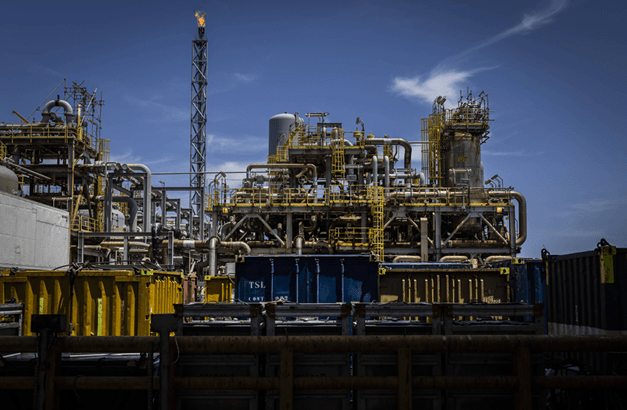
Petrobras oil platform in Espírito Santo (Photo: Bruno Santos – 1 March 2024/Folhapress)
Nicolas Lippolis
Economist and political scientist, researcher at the Columbia Climate School and founder of the think tank Centre for Energy, Finance and Development
[SUMMARY] The author argues that, in addition to reducing the demand for fossil fuels — whose interests have funded decades of denialism — it is necessary to make progress in cutting supply by reducing subsidies for oil and natural gas production and promoting energy and economic diversification policies for producing countries.
As the main drivers of climate change, fossil fuels did not feature in the final text of COP30, held in Belém. Even so, they dominated the debates.
At the Leaders’ Summit, Lula proposed a ‘roadmap’ to phase them out, and over the following two weeks, more than 80 countries embraced the idea. The Arab group and the bloc of developing countries led by India resisted. There was no consensus, but after three decades of climate conferences, fossil fuels are, once and for all, at the centre of the table and will not leave anytime soon.
In the final plenary, the president of COP30, André Corrêa do Lago, announced that the design of both the roadmap for phasing out fossils and the one to end deforestation will be led by Brazil throughout 2026. Colombia and the Netherlands announced the first international conference exclusively dedicated to discussing the end of fossil fuels, scheduled for April 2026 in Santa Marta, Colombia.
Both initiatives will run parallel to the UNFCCC (United Nations Framework Convention on Climate Change) system during a year that promises to be decisive. While the legitimacy of multilateral consensus may be lost, agility and the ability to bring both oil producers and consumers to the table are gained.
The big question the roadmap will have to address is: who abandons fossil fuels first, and in what order? In theory, there are possible criteria, each carrying distinct philosophies of climate justice: size of reserves, extraction costs, associated emissions, economic and fiscal dependence, level of development, and institutional capacity. Combining all this into a single indicator will be a Herculean task.
Other questions are equally challenging. Will coal, oil, and gas have a single exit route or separate paths? Which will be targeted more: demand or supply? Who will have the courage to apply moratoria to all exploration and production projects? What are the other concrete instruments to implement a future roadmap?
Coal is a case apart, consumed where it is extracted, mainly in Asia. Its end depends less on global trade and more on renewable financing, grid integration, and a just transition for miners.
Oil and, to a lesser extent, gas travel the world via ships and pipelines, allowing production and consumption to be decoupled. Reducing the demand for fossils by investing in renewable energy, biofuels, and energy efficiency is what almost the entire world is doing — including Brazil, which claims it will be carbon neutral by 2050, but before then will become one of the five largest oil producers on the planet.
There is no doubt: replacing fossil fuels with renewables is the most effective way to cut emissions. However, reducing demand alone may not be enough. Fossil interests are resilient and have already funded decades of denialism. Without supply planning, the risk is creating stranded assets and fiscal crises in producing states.
Real price and supply control
There are precedents for restricting supply: the UK, Colombia, and other smaller producers, such as Denmark, France, and Costa Rica, have decreed an end to new licences.
The British Labour government maintained this decision even in the face of resistance. The British phase-out was preceded by a windfall tax on oil companies’ profits, but few of the funds obtained so far have been directed towards creating new jobs for industry workers — a prerequisite for a just transition.
Gustavo Petro’s Colombia announced the end of new concessions in 2023. In the absence of adequate planning, and while its gas production was already falling, it became an importer of American gas.
As a backlash, the main candidates for the 2026 presidential elections have been advocating for drilling, including using environmentally destructive techniques. The Colombian lesson is clear: without parallel energy and economic diversification, supply-side policies fail politically.
Financial restrictions remain rare. Since the Paris Agreement, the largest banks have lent US$7.9 trillion to the fossil sector. The Net Zero Banking Alliance lost momentum with the war in Ukraine and died completely with the election of Donald Trump. Profit won over purpose.
The Brazilian government repeatedly states that if we do not explore the Equatorial Margin, others will take our market share. In practice, oil producers do not replace one another that easily, and a reduction in supply can indeed help lower demand. But of course, rich countries must lead by example.
In a world where economic interests continue to override climate concerns, the roadmap cannot merely be an exercise in voluntarism — it must create real incentives and recognise countries’ legitimate pursuit of energy security and autonomy in their foreign relations.
One shortcut is to remove obstacles that prevent even well-intentioned governments from acting. International arbitration tribunals have already ordered states to pay hundreds of millions of dollars in compensation for cancelling fossil licences, even though there are ways to implement phase-out policies without incurring arbitral risks. The foreign investment protection regime has become a climate barrier and will have to step aside.
Brazil at the starting line
Another blind spot is production subsidies that artificially cheapen extraction and fuel an incentive rally among producing countries. These include public financing and tax exemptions, such as Repetro — the special customs regime for goods in the oil and natural gas industry — which accounts for R$13.6 billion of the R$47 billion in subsidies granted to the sector in Brazil in 2024.
Globally, production subsidies for fossil fuels account for 15% of the total but are even more perverse than consumption subsidies, as they drain public money without benefiting citizens and intensify predatory competition to attract investment. Reforming them requires internationally aligned methodologies, the creation of national inventories, and the sharing of experiences.
Brazilian civil society has its own methodologies for measuring production subsidies, which could serve as a basis for government initiatives. The success on the consumption front, achieved over the past three years, puts Brazil in a position to lead from the start.
We possess rare advantages — an electricity mix that is 90% renewable, a flex-fuel fleet, and Petrobras with cutting-edge technology — which can be leveraged to export green industrial products, sustainable fuels, and bioeconomy products. However, we must move beyond rhetoric and permanently cut the incentives that are still holding us back.
For more dependent countries, particularly the petro-states of the Middle East and Africa, the challenge is existential. Bilateral or regional programmes that guarantee market access while reducing methane and building alternatives — such as the Methane Abatement Partnership Roadmap launched at COP29 — could be the embryo of greater cooperation: importers and exporters aligning demand and supply reductions. Multiplied, these agreements pave the way for ambitious proposals, perhaps even a fossil fuel non-proliferation treaty.
According to the International Energy Agency, if governments deliver on the policies they have already announced, demand for coal and oil could peak within this decade.
Keeping our foot on the accelerator of the goal to triple renewable energy mixes and energy efficiency promised in Dubai is essential, but insufficient without equivalent measures on the supply side.
Even if the roadmap is charted on the fringes of the COP, it remains an indispensable tool towards the end of the fossil era. Since Rio-92, Brazil has demonstrated its capacity to lead with creative solutions, and 33 years later, the Tropical Rainforests Forever Fund is an exemplary case.
Now, the country has the chance to repeat this feat, provided it avoids the easy rhetoric that places the entire burden on consumption and incorporates, with equal boldness, supply restriction instruments. Only then will the map be not just a piece of guidance, but the actual roadmap for a post-fossil world.