Oil returns to the centre of global geopolitics after US action in Venezuela: what changes in the markets
American invasion reignites debate over commodities, whilst investors monitor effects in Brazil and emerging markets
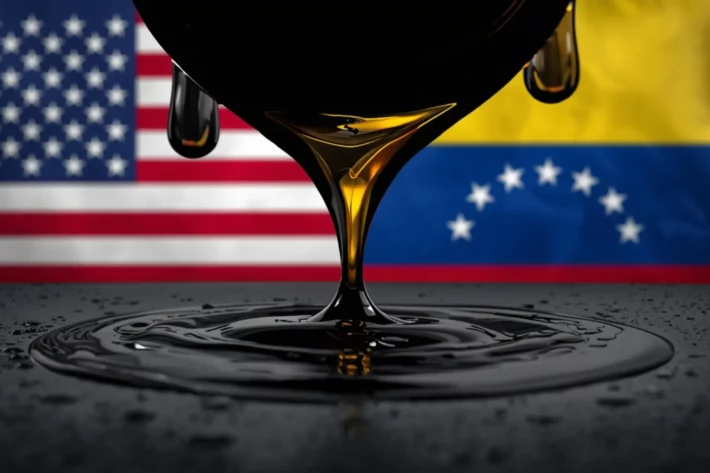
(US oil company shares advance on potential exploration of Venezuela’s reserves — Photo: Adobe Stock)
The United States offensive in Venezuela has brought back to the table a relationship marked by sanctions, political disputes, and a direct interest in oil. The invasion, associated with US President Donald Trump, targeted the country’s strategic infrastructure and heightened pressure on Nicolás Maduro’s government, in a move that Washington frames as a security and anti-illicit activity action. In practice, the episode reignites the discussion on the future of Venezuelan reserves — the largest in the world — at a time of reorganisation in the global energy market.
Despite rising diplomatic tensions and reports of casualties, financial markets reacted smoothly. In New York, major stock indices made moderate gains, with investors concentrating positions in energy companies and banks. The prevailing view among experts points to a localised political event, fitting into a well-known history of friction between the two countries.
Oil prices fluctuated upwards at times, influenced both by geopolitical risk and announcements regarding the potential delivery of up to 50 million barrels of Venezuelan oil to the US.
Volatility indicators confirmed this tone. The VIX (Volatility Index), known as the ‘fear index’, rose marginally and remained far from the levels observed during larger-scale international crises. In Brazil, the Ibovespa varied little, whilst the dollar showed discreet adjustments against the real.
Even so, gold, metals, and defence sector shares gained ground in investors’ portfolios, signalling a posture of selective caution in the face of a conflict that remains on the radar and depends on the next moves by Washington and Caracas.
For Gerson Brilhante, an analyst at Levante Inside Corp, the signals coming from Trump point towards a foreign policy guided by ad hoc negotiations, with less weight given to traditional institutions. This approach increases unpredictability surrounding rules, sanctions, and alliances, leading investors to seek protection in defensive and hard assets such as gold, oil, metals, and other real assets used as a store of value.
Even so, he notes, the market has not yet revised its core projections for the global economy.
What to expect in the medium and long term
In the medium-term view, Natalie Verndl, a delegate of the Regional Economics Council of São Paulo (Corecon SP), assesses that the political direction of the intervention becomes decisive for the markets. If Venezuela manages to stabilise and resume trade with other countries, the move could unlock investments in energy and infrastructure. This tends to generate positive effects across commodity-linked supply chains throughout Latin America.
Conversely, a prolonged US involvement, marked by continuous tension, typically brings greater caution to investors, exerting pressure on the dollar, making foreign capital more expensive, and increasing the sensitivity of Brazilian shares.
‘Furthermore, there will be a need, at least in the medium and long term, for these investors to start pricing in the risk of greater American intervention, recalibrating their expectations for economic policies in regional terms, not only in Brazil but across Latin America,’ states Verndl.
This reading helps explain the analysis by Gabriel Stievano Giannoni, director of products and operations at Mêntore. In his view, the first effect appears in prices, which begin to fluctuate more, particularly in commodities and credit-linked assets. This environment typically drives some investors to seek protection.
Over time, if greater predictability emerges, the energy market could reorganise, opening up space for opportunities linked to Venezuelan debt and changing the game for raw material-exporting countries such as Brazil.