Between energy security, responsible development and the challenges of the transition
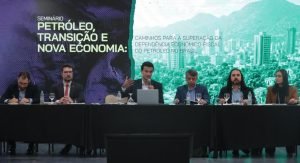
The Brazil Climate Futures Forum panel, held at Columbia University during New York Climate Week 2026, brought together different perspectives on the future of oil production in Brazil, its economic and fiscal effects, energy security, local impacts and the challenges of a low-carbon transition.
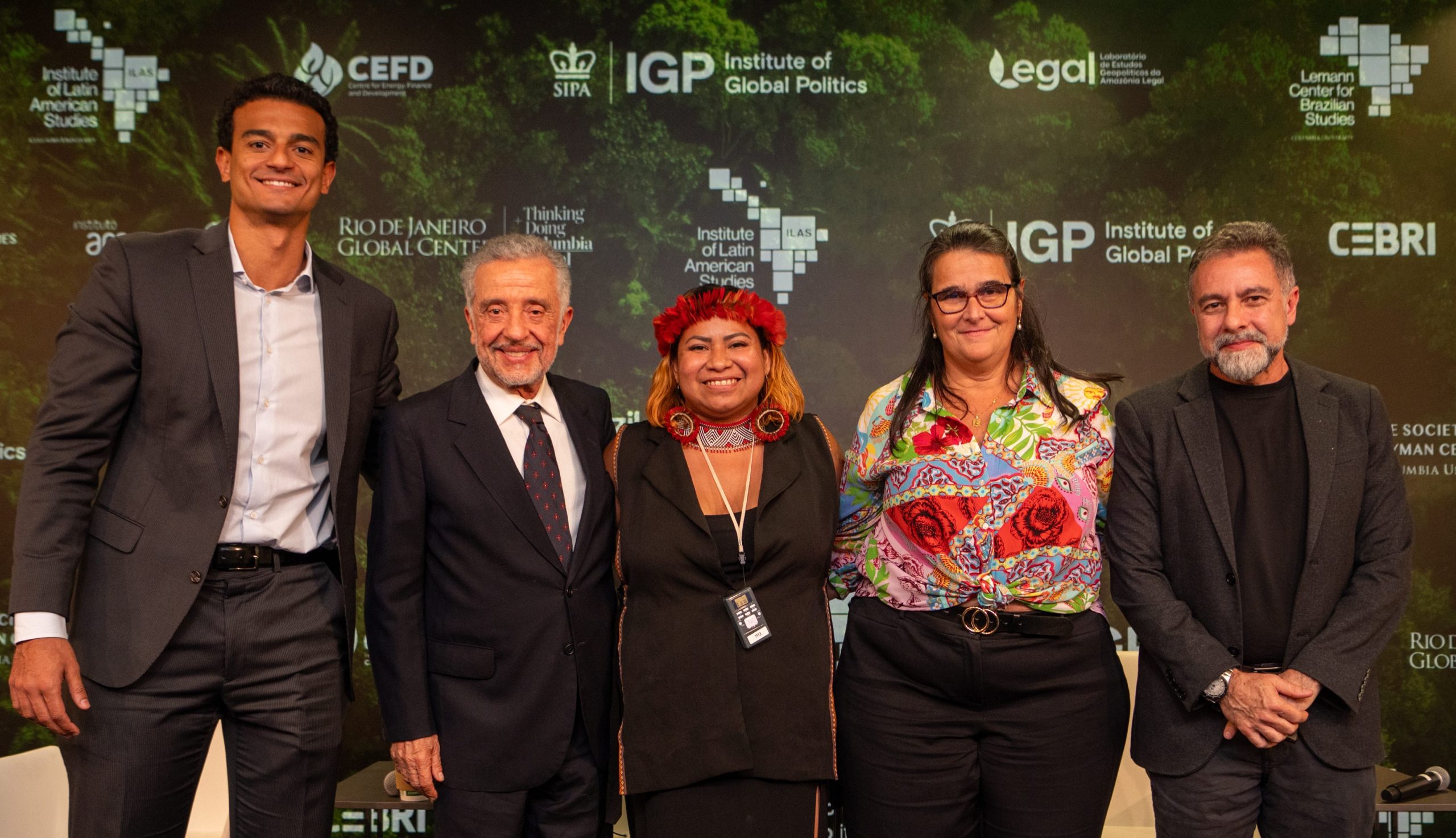
The expansion of oil production, energy security and Brazil’s climate commitments were at the centre of the panel “Oil and the Energy Transition”, held as part of the Brazil Climate Futures Forum at Columbia University during New York Climate Week. The event, held on 24 September 2026, brought together researchers, civil society representatives, and public and private sector stakeholders to discuss Brazil’s economic, environmental and social transformations.
Moderated by economist and political scientist Dr Nicolas Lippolis, founder and executive director of the Centre for Energy, Finance and Development (CEFD), the panel brought together José Pio Borges, Chair of the Board of Trustees of the Brazilian Centre for International Relations (CEBRI) and former President of the Brazilian Development Bank (BNDES); Luene Karipuna, Executive Director of the Articulation of Indigenous Peoples and Organisations of Amapá (APOIANP) and an Indigenous leader from Oiapoque, Amapá; Rosana Santos, Executive Director of Instituto E+ Transição Energética; and Márcio Astrini, Executive Secretary of the Climate Observatory.
The discussion began with the weight that oil still carries in the Brazilian economy. “US$44.5 billion was the amount Brazil earned from crude oil exports last year, making it Brazil’s leading export product,” said Lippolis.
The Equatorial Margin, considered the new frontier for oil exploration in Brazil, has been presented by economic and political actors as an opportunity to expand production and generate revenues for lower-income regions.
“The myth that oil will necessarily bring development is not dispelled. We have seen this, for example, in a neighbouring country, Venezuela. CEFD also works in Africa, and this is also happening in many African oil-producing countries. There is often an incentive for political elites to overstate the benefits of oil because the revenues generated ultimately accrue to them,” Lippolis pointed out.
Changes in the Territories
The arrival of a new economic activity without adequate planning is putting public services under strain and deepening existing problems in the region. Research began three years ago in Oiapoque, in the far north of Amapá, initially in connection with a Petrobras facility.
“My territory has changed completely. Seven new neighbourhoods were created in three years. The people who are now in Oiapoque, hoping to improve their lives, will not see that change in the short term. They are experiencing a situation that will create social problems. So, when we talk about the energy transition, we need to talk about the Brazilian government’s preparation for this transition,” said Luene Karipuna.
The economic, social and environmental effects can reach coastal communities and Indigenous peoples. “What does offshore mean to you? It is far from your home, but it is inside my home. It is in a sacred place. […] The exploration has already created pressure, driven real estate speculation and brought illegal mining into the territory,” she added.
Karipuna argues that social participation should take place before projects are defined, including consultation with Indigenous peoples before block auctions. She cited consultation protocols developed by the Wajãpi people in Amapá, which serve as a regional reference for defending the right to free, prior and informed consultation.
José Pio Borges highlighted that Brazil has expanded its exports to markets such as China, India and Europe, increasing its importance to international energy security. “Brazil is a great alternative for people who have depended too heavily on the Middle East,” he said, emphasising Brazil’s low production costs. “Oil will remain relevant for at least one generation,” Borges added, noting that electrification, particularly in China, is one of the factors that could change this scenario.
With oil demand expected to decline over the coming decades, Rosana Santos drew attention to the risk that long-term investments could become economically unviable. She stressed that decisions on new infrastructure need to take the ongoing energy transition into account, particularly in light of accelerated electrification.
“We currently have an oil price scenario that will not necessarily be the future oil price. If we build major oil and natural gas exploration and distribution infrastructure based on current prices, we could end up with stranded assets.”
The Ten-Year Energy Expansion Plan, an integrated planning instrument designed to set out prospects for the expansion of Brazil’s energy sector, projects approximately 80% of energy sector investments to be directed towards fossil fuels, mainly oil and gas.
However, even though Brazilian energy policy still directs most investment towards the oil and gas sector, the need to reduce fossil fuel production and consumption is strongly supported by scientific evidence, Márcio Astrini stressed, highlighting the climate impacts and consequences of expanding supply.
Revenue and royalties
The allocation of sector revenues brought the positions presented on the panel closer together. Santos argued that royalties should be used to diversify the economies of producing territories, with rules capable of turning oil revenues into productive investment and preparing economies for a reduction in their dependence on oil.
The challenge lies in the rules governing how these resources are used. Only through planning can the temporary revenues from a finite resource such as oil, beyond financing expenditure, create the conditions for a more diversified and less unequal economy. At present, more than half of the oil revenues allocated to subnational governments is concentrated among a small number of governments, Dr Lippolis noted. The state of Rio de Janeiro alone receives 82% of the total.
Rosana concluded: “If oil is going to be explored, then this money should be used to prepare the economy for a future without oil, and with social and economic development for the territories.” Making use of Brazil’s predominantly renewable electricity mix to expand its participation in higher-value international industrial supply chains, involving infrastructure, technology, skills development and financing, should be the country’s priority.