Ricardo Kotz
Abstract
This policy paper analyzes the outcomes of Chinese investment in Brazil’s power sector between 2014 and 2025, focusing on solar and wind generation and the transmission infrastructure that enables it. Drawing on case studies of the four dominant state-owned enterprises—State Grid, China Three Gorges, State Power Investment Corporation, and China General Nuclear—it examines how these investments have shaped the country’s energy infrastructure and assesses their effects on the development of local technological and productive capabilities. It finds that Chinese foreign direct investment (FDI) in renewable energy significantly expanded installed capacity but generated limited spillovers for technological and industrial upgrading, largely because of weak local embeddedness mechanisms and Chinese companies’ vertical-integration strategies. The study concludes that Brazil has the institutional tools to steer this investment toward productive development, but that the window for doing so is narrowing over time.
Keywords: China; Brazil; power sector; foreign direct investment; industrial policy; energy transition.
Key Findings
- China has implemented industrial and energy policies—including the Five-Year Plans, the Dual Carbon Plan, and the Belt and Road Initiative—to position itself as a global leader in renewable energy, with influence over the governance of strategic supply chains.
- Between 2014 and 2025, Chinese state-owned enterprises invested US$22.33 billion in Brazil’s power generation and transmission sectors, especially in wind, solar, and hydropower projects, making China the country’s largest foreign investor in energy infrastructure during this period.
- Four state-owned enterprises dominate the investment landscape: State Grid, CTG, SPIC, and CGN. Each combines acquisitions of existing assets, upgrades to operating facilities (brownfield), and the selective development of new projects (greenfield) in wind, solar, hydropower, and electricity transmission.
- Investment is geographically concentrated in Brazil’s Northeast, especially in the post-Covid period, where solar and wind resources are most abundant. This concentration is creating an emerging renewable-energy hub, but it has not yet produced dense industrial ecosystems.
- The predominant modes of entry—mergers and acquisitions and the modernization of existing assets—rapidly expand generation capacity but offer few opportunities for technology transfer. Brazil should differentiate its incentives by entry mode, reserving the most favorable public-credit conditions for greenfield projects and joint ventures that include supplier-development commitments.
- Chinese foreign direct investment (FDI) strengthens infrastructure by expanding power generation and transmission capacity, accelerating the deployment of renewable sources, and improving grid reliability. However, benefits for local industrial development (industrial spillovers) remain limited: supply chains continue to depend on imports, while higher-value-added activities remain concentrated in China.
- The central finding of this analysis is that Chinese FDI in Brazil’s renewable-energy sector expands energy infrastructure but does not promote structural transformation. It therefore advances the energy transition without significantly strengthening the country’s industrial and technological capabilities (upgrading).
- Technology transfer and upgrading remain limited because Chinese companies prioritize vertical-integration strategies aimed at supply-chain control and efficiency rather than the integration of local suppliers.
- This dynamic produces a paradoxical pattern: substantial progress in the energy transition accompanied by modest gains in industrialization and technological development.
Introduction
China’s domestic transformation over the past decade—marked by the rapid scaling of industrial capabilities in solar power, wind power, batteries, and electric vehicles—has produced significant overcapacity in clean technologies. This phenomenon has reshaped not only China’s energy system but also the pattern of its overseas investment. As Chinese companies faced an increasingly saturated domestic market, they directed capital, technology, and manufacturing capacity to other countries through various strategies, including greenfield investment, mergers and acquisitions, joint ventures, and supply-chain integration.
These financial flows are helping reshape the pace, cost, and political economy of energy transitions in recipient countries. Latin America has become a particularly important region, and Brazil stands out as a critical case: as Latin America’s largest economy and energy market, it is the leading destination for Chinese foreign direct investment (FDI). The portfolio of Chinese companies investing in Brazil has evolved from oil, gas, and agriculture toward growing participation in renewable energy, electricity generation and transmission, and electric mobility.
Brazil is therefore an essential case for analysis. It combines a large domestic market, clear reindustrialization objectives aimed at strengthening renewable-energy and other clean-energy production chains, and a complex regulatory environment. The Brazilian case provides an important reference point for understanding the dynamics of FDI, dependency, and development in Latin America. To that end, this policy paper analyzes solar- and wind-energy foreign direct investment (FDI) projects undertaken in Brazil between 2015 and 2024 by the Chinese state-owned enterprises State Grid, China General Nuclear (CGN), State Power Investment Corporation (SPIC), and China Three Gorges (CTG).
The paper is organized as follows. The first section contextualizes the expansion of renewable energy in China through the public-policy architecture that guided its transition, taking the country from a financier of fossil fuels to a global clean-energy leader in less than two decades. The second section presents an overview of Chinese investment in Brazil’s wind and solar sectors between 2015 and 2024, mapping its scale and geographic distribution. In addition to the entry modes of the four predominant state-owned enterprises, it examines Goldwind, a wind-turbine manufacturer whose operating strategy differs from those of the other companies analyzed. The third section presents case studies of State Grid, CTG, SPIC, and CGN, analyzing how each has entered Brazil’s power system through distinct but complementary strategies. The fourth section assesses the development effects of these investments, examining their impact on infrastructure expansion, local industrial development (industrial spillovers), and technological upgrading.
Industrial Policies and the Architecture of China’s Energy Transition
China’s renewable-energy policy framework is remarkably complex, characterized by overlapping policies across ministries, provincial authorities, and state agencies that operate simultaneously toward shared objectives. The country has adopted a dual-track approach: broad economy-wide policies designed to accelerate the clean-energy transition, combined with targeted measures for specific segments of the renewable-energy industries. The 14th Five-Year Plan for Renewable Energy Development (2021–2025) is one of the most ambitious expressions of this strategic orientation. It set targets to reduce energy consumption per unit of GDP by 13.5 percent and CO₂ emissions per unit of GDP by 18 percent relative to 2020 baseline levels, while increasing non-fossil sources to 20 percent of total energy consumption. It also established a target of 1,200 GW of installed wind and solar capacity by 2025—a threshold surpassed in 2024, when capacity exceeded 1,600 GW.1
The 15th Five-Year Plan (2026–2030) signals continuity with the 14th Plan by emphasizing sustainable industrial production, expanded clean-energy capacity, and increased public investment in research and development. It reinforces the need for technological self-sufficiency and the goal of making Chinese companies global leaders in segments at the international technological frontier, especially renewable energy and high-tech manufacturing. Alongside these policies is the Dual Carbon Implementation Policy (DCIP), which is not a standalone document but a comprehensive architecture built around two central goals: peaking carbon emissions by 2030 and achieving carbon neutrality by 2060.
Despite China’s high pollutant emissions, its global environmentalism represents substantial progress compared with the 2001–2015 period, which was marked by financing for overseas hydrocarbon projects. Beijing’s current posture is anchored in strategic and economic imperatives as well as reputational considerations—a combination that produces an unusual convergence of environmental, development, and security objectives. Increasingly assertive on the international stage, China now claims leadership in developing clean technologies and renewable energy while portraying Western positions as inattentive to the development needs of the Global South.2
Against this backdrop, Beijing recently published two major white papers: “China’s Green Development in the New Era” (2023) and “China’s Energy Transition and Global Cooperation” (2024), which articulate the country’s domestic guidelines and engagement with international partners. The two documents are organized around three pillars: (1) encouraging consumption of goods produced with renewable energy; (2) creating a new energy-supply system by raising electrification rates and the share of renewables in the energy mix; and (3) fostering “new quality productive forces” through technological innovation. These new “productive forces” take shape through two types of actors, both examined in this policy paper (chapter 3): private companies that manufacture and export wind turbines and solar panels, and state-owned enterprises that invest in acquiring and building renewable-power facilities throughout the Global South.
In Beijing, the promotion of economic development was coupled with an understanding that countries dominating new waves of technological change accumulate resources that can be converted into power and influence internationally. In coal, oil, internal-combustion vehicles, and other established industries, China arrived late, after the advanced Western economies already dominated the leading markets and technologies. Renewable energy—and later electric vehicles—offered a different configuration. In the early 2000s, Beijing identified a window of opportunity to move closer to the international technological frontier and then directed industrial policy and long-term financing toward these sectors over the following two decades.3 Table 1 summarizes China’s policy framework for the energy transition and renewable energy.
Table 1: China’s Main Policies for the Energy Transition and Renewable-Energy Sectors
| Policy / Strategy | Type | Time Frame | Institutions | Instruments | Targets and Focus |
|---|---|---|---|---|---|
| 14th Five-Year Plan for Renewable Energy Development | National Energy Plan | 2021–2025 | NDRC, NEA, MIIT | Capacity targets, consumption-reduction targets, clean power grids | Reduce energy intensity (-13.5%) and CO₂ emissions (-18%); non-fossil sources (20% of energy; 39% of electricity); 3,300 GW of capacity |
| Dual Carbon Implementation Policy (DCIP) | Cross-Cutting Framework | Ongoing (2030/2060) | NDRC, Ministry of Ecology and Environment | Carbon pricing, green finance, energy optimization | Peak carbon by 2030 and carbon neutrality by 2060; grid decarbonization; clean industrial transition |
| China’s Green Development in the New Era (White Paper) | Strategic Vision | 2023–ongoing | State Council | Narrative, policy alignment | Green consumption, green supply chains, productive innovation in manufacturing |
| China’s Energy Transition and Global Cooperation | Strategic and Diplomatic | 2024–ongoing | State Council | Global cooperation, energy diplomacy | Global role through the Belt and Road Initiative; green energy in partnerships; “new quality productive forces” |
| Carbon Peaking and Carbon Neutrality: China’s Plans and Solutions | Policy and Diplomacy | 2025–ongoing | State Council of the PRC | Domestic policy and energy diplomacy | Reaffirmation of the Dual Carbon Policy commitment to reducing CO₂ emissions |
| 15th Five-Year Plan (FYP) (2026–2030) | Comprehensive and Integrative | 2026–ongoing | NDRC and State Council | GDP growth, priority sectors, external partnerships, and BRI | Technological self-sufficiency (renewables and EVs); continued decarbonization |
| Belt and Road Initiative (BRI) – Green Energy | Strategic and Diplomatic | 2015–ongoing | State Council, NDRC, MOFA | Export of clean projects, FDI | International cooperation on green energy; clean infrastructure and investment in the Global South |
Source: CEFD, based on annual documents from the State Council of the People’s Republic of China (2021–2025).
Chinese Investment in Brazil’s Solar and Wind Sectors
The power sector is by far the main destination for Chinese capital in Brazil: it absorbed 45 percent of the US$85.5 billion invested across 355 projects between 2007 and 2025.4 Chinese companies investing in solar and wind energy have expanded significantly since the 2010s, driven by market-seeking motives and the need to deploy excess productive capacity. Their preference for Brazil’s power sector reflects the country’s structural advantages, including abundant natural resources and a large domestic market.
A defining feature of Chinese FDI in Brazil’s solar and wind sectors is the role of large state-owned enterprises (SOEs), including State Power Investment Corporation (SPIC), China Three Gorges (CTG), and China General Nuclear (CGN). These companies typically enter the Brazilian market through mergers and acquisitions, then expand the solar, wind, and hydropower capacity of the assets acquired. As plant capacity expands, these investments generate demand for wind turbines and solar panels manufactured in China by private or mixed-ownership companies.
This dual structure, or integrated strategy, allows Chinese companies not only to operate generation assets in Brazil but also to support manufacturing in their home country, reinforcing links between the two sectors. Investment has increasingly shifted toward Brazil’s Northeast, where wind and solar resources are more abundant, indicating gradual diversification beyond the traditional economic centers of the South and Southeast.
More than 80 percent of State Grid Corporation of China’s overseas investment in power grids is concentrated in Latin America, and Brazil accounts for more than 60 percent of that portfolio through high-voltage electricity-generation and transmission projects.5 Despite the scale and strategic importance of these investments, their effects on local development remain uneven and depend on domestic institutions and each region’s context. Chinese FDI has helped close financing gaps in Brazil’s energy sector and accelerated renewable-capacity deployment, particularly through capital-intensive projects and infrastructure expansion. On the other hand, extensive vertical integration and reliance on imported components can limit local technological spillovers and supplier development.6 The main Chinese FDI projects in Brazil’s solar and wind sectors are summarized in the following table:
Table 2: Major Chinese Foreign Direct Investments in Brazil’s Power Sector (2014–2024)
| YEAR | PROJECT · COMPANY | SECTOR · MODE | INVESTMENT (US$) | REGION |
|---|---|---|---|---|
| 2014 | 1 Belo Monte – UHVDC Transmission Lines – Phase IState Grid (SGBH)2,100 km line | TransmissionGreenfield | 646 million | North: Pará to Minas Gerais (via Tocantins and Goiás) |
| 2017 | 2 CPFL Energia (54.64%)State Grid (SGBH)Initial acquisition | Power utilityMerger and acquisition (M&A) | 4.1 billion | Southeast/South: based in São Paulo, with power generation serving São Paulo, Rio Grande do Sul, Minas Gerais, and Paraná |
| 3 Increased stake in CPFL (94.75%)State Grid (SGBH)Ownership consolidation | Power utilityMerger and acquisition (M&A) | 5.4 billion | Same region as above | |
| 2017 | São Simão Hydroelectric Power PlantSPICFull acquisition | Merger and acquisition | 2.25 billion | Southeast: Minas Gerais |
| 2019 | 4 Belo Monte – UHVDC Transmission Lines – Phase IIState Grid (SGBH)2,539 km line | TransmissionGreenfield | 2 billion | North, Central-West, and Southeast: Pará, Tocantins, Goiás, Minas Gerais, and Rio de Janeiro |
| 5 Nova Olinda / Lapa / CristalândiaCGNFrom Enel | Renewable energyAcquisition | 700 million | Northeast: Bahia | |
| 6 Atlantic Renewable EnergyCGNFrom Actis | WindAcquisition | 1 billion | Northeast: Piauí, Rio Grande do Norte, Bahia | |
| 7 Santa Vitória do PalmarCGN | WindAcquisition | 20 million | South: Rio Grande do Sul | |
| 2021 | 9 Lagoa do Barro do Piauí Expansion CGN | WindBrownfield | 80 million | Northeast: Piauí |
| 10 Stake in Marangatu SolarSPIC | SolarAcquisition | 60 million | Northeast: Piauí | |
| 11 Stake in Gás Natural Açu I and IISPICMinority stake | Thermal powerAcquisition | 1.54 billion | Southeast: Rio de Janeiro | |
| 2022 | 12 Marangatu & Panati-SitiáSPICMajority stake | SolarAcquisition | 403 million | Northeast: Piauí and Ceará |
| 2023 | 13 Tanque Novo Wind FarmCGN | Wind | 228 million | Northeast: Bahia |
| 14 Wind-Turbine Blade FactorySinoma Blade | Manufacturing | 20 million | Northeast: Bahia | |
| 15 Boa Esperança & JusanteState Grid | Solar | 160 million | Southeast: Minas Gerais | |
| 16 GATE Transmission ProjectState Grid1,600 km | TransmissionGreenfield | 2 billion | Northeast: Maranhão, Tocantins, Goiás | |
| 2023–24 | 17 Arinos Solar ComplexCTG412 MW | SolarGreenfield | 200 million | Southeast: Minas Gerais |
| 2024 | 18 Serra da Palmeira Wind ComplexCTG648 MW | WindGreenfield | 740 million | Northeast: Paraíba |
| 19 Hydropower ModernizationCTGEfficiency gains | HydropowerBrownfield | 590 million | São Paulo and Mato Grosso do Sul | |
| 20 Wind-Turbine FactoryGoldwind | ManufacturingBrownfield | 27 million | Northeast: Bahia | |
| 21 Camaçari PlantGoldwindFormer GE plant | ManufacturingAcquisition | 20 million | Northeast: Bahia | |
| 22 Solar-Tracker FactoryTrina Solar | Manufacturing | 20 million | Northeast: Bahia | |
| 2025 | 23 Lagoinha Solar ExpansionCGN | SolarBrownfield | 131 million | Northeast: Ceará |
| Total | 22.335 billion |
Source: CEFD, based on China-Brazil Business Council reports on FDI (2016, 2018, 2020, 2024, 2025); American Enterprise Institute (2025); and the ICLAC Milenio Group Repository (2024).
* Row present in the working version of the table but absent from the original file; investment value and region to be confirmed.
The Political Economy of Chinese FDI in Brazil’s Solar and Wind Sectors: Company Case Studies
This section examines the main foreign direct investment (FDI) projects undertaken by Chinese companies in Brazil during the period analyzed in this policy paper. The companies are State Power Investment Corporation (SPIC), State Grid, China Three Gorges (CTG), China General Nuclear Power Group (CGN), State Grid Brazil Holding (SGBH)—a subsidiary of State Grid Corporation of China (SGCC)—and Goldwind.
State Power Investment Corporation (SPIC): A Case of Diversification
State Power Investment Corporation (SPIC) is a state-owned enterprise created in 2015 through the merger of China Power Investment Corporation and State Nuclear Power Technology Corporation. In addition to the nuclear-generation assets it inherited, SPIC has consolidated a diversified energy portfolio over the past decade encompassing hydropower, nuclear, wind, solar, and biomass generation. With 187 GW of installed capacity and approximately 130,000 employees, the company is a central instrument of China’s external energy strategy and industrial policy.7
SPIC’s internationalization strategy reflects both capital exports and geoeconomic positioning. Its overseas renewable-energy investments serve a dual purpose: securing long-term returns in profitable markets and projecting technological leadership in low-carbon sectors. Although its overseas capacity—6.65 GW in operation and 1.72 GW under construction—remains modest compared with its domestic operations, the concentration in renewables (73 percent of overseas assets) signals alignment with China’s decarbonization and green industrial-upgrading agendas.8
In Brazil, SPIC’s asset portfolio reveals a strategy that combines the acquisition of legacy infrastructure with greenfield renewable-energy investment. The São Simão Hydroelectric Power Plant, commissioned in 1978 and acquired by SPIC in 2017, illustrates the acquisition-followed-by-modernization model. The plant has been undergoing upgrades since 2020, with completion scheduled for 2029, to improve efficiency, output, and asset life. This reflects a broader pattern in which Chinese state-owned enterprises deploy financial capacity and engineering expertise to extract value from aging infrastructure in emerging markets. Investing in existing assets avoids many of the regulatory and procedural obstacles involved in building new plants.
At the same time, SPIC’s investments in solar hubs such as Marangatu (446 MW), Panati-Sitiá (292 MW), and Luiz Gonzaga (114 MW) signal a shift toward renewable-energy expansion in the high-irradiation areas of Brazil’s Northeast. Together, they contributed to a 33 percent increase in SPIC’s renewable-generation capacity in the Brazilian market.9 These projects position the company within Brazil’s renewable-energy auction system while reinforcing the expansion of China’s global solar value chain. SPIC’s presence in wind energy, although smaller, complements this diversification strategy and reflects gradual market penetration through both operating assets and new projects.
China Three Gorges (CTG): From Hydropower to Wind and Solar
China Three Gorges (CTG) Brasil occupies a more established position in Brazil’s power sector. Created in 2013, the state-owned enterprise’s Brazilian affiliate quickly assembled an 8.3 GW generation portfolio and became one of the leading foreign players in Brazil’s energy mix. Unlike SPIC’s mixed entry strategy, CTG relied heavily on acquisitions of large hydropower assets, embedding itself in a power system historically dependent on hydropower. Control of twelve hydroelectric plants, combined with equity stakes in other facilities, constitutes a model of strategic asset consolidation that secures stable revenue through long-term power-purchase agreements and regulated returns. At the same time, its expansion into solar (the 412 MWp Arinos Complex in Minas Gerais) and wind (the 648 MW Serra da Palmeira project in Paraíba) signals adaptation to Brazil’s ongoing energy transition and to diversification imperatives.10
The company’s large-scale modernization initiatives, especially at the Jupiá and Ilha Solteira plants, exemplify the use of technological upgrading to extract value and improve efficiency through gains in output and water use. These interventions illustrate a broader strategy among Chinese state-owned enterprises that combines capital and engineering to raise the productivity of existing infrastructure. It is important to note, however, that CTG Brasil’s involvement in innovation domains—green hydrogen, blockchain-based energy certification, and artificial-intelligence-enabled grid management—stems largely from ANEEL’s mandatory Research and Development (R&D) Program. The program requires all electricity concessionaires in Brazil to invest a fixed share of net revenue in regulator-approved R&D projects. In financing terms, CTG’s acquisition of hydropower assets relied on a hybrid structure involving resources from the Brazilian Development Bank (BNDES), corporate equity, and commercial banks, revealing the importance of Brazilian institutions and state capacity in attracting FDI and anchoring it in local economies.
China General Nuclear (CGN) in Brazil: Expansion Through Acquisitions
China General Nuclear Power Group (CGN) grew in Brazil by purchasing assets that were already operational. Its entry in 2019 came through the acquisition of Atlantic Energias Renováveis, and the pattern would recur, reflecting a characteristic feature of Chinese outward FDI in strategic infrastructure sectors. From a political-economy perspective, CGN’s trajectory illustrates how Chinese state-owned enterprises use brownfield investment to rapidly internalize operating assets, circumvent entry barriers, and secure immediate revenue streams. This approach contrasts with greenfield investment, which generally creates deeper local linkages but requires longer maturation periods. CGN’s expansion is therefore aligned with risk-averse accumulation that prioritizes asset consolidation over the development of endogenous capabilities in recipient countries.
CGN Brasil now operates a portfolio that is geographically concentrated but technologically diversified: seven wind complexes and three solar parks in several states, with combined installed capacity exceeding 1.4 GW. The concentration of assets in the Northeast—characterized by high solar irradiation and strong wind potential—reflects both resource optimization and the spatial logic of renewable-energy expansion in Brazil. The connection of all operating units to a centralized monitoring system linked to the National Electric System Operator (ONS) further demonstrates the company’s incorporation into national grid-governance structures and reinforces its embeddedness in Brazil’s power system.
A defining feature of CGN’s operating model is the extensive use of special-purpose entities (SPEs) to manage individual assets and projects. This structure increases financial flexibility and risk segmentation, but it also reflects a global infrastructure-finance trend toward fragmented ownership and project-based governance—which may complicate regulatory oversight and dilute local development spillovers. CGN’s solar portfolio, particularly the Nova Olinda Solar Park (292 MW) and the Bom Jesus da Lapa complex (158 MW), illustrates large-scale deployment of photovoltaic infrastructure that benefits from economies of scale and standardized technological configurations.
In wind power, CGN’s portfolio includes Tanque Novo (180 MW) and Morrinhos (180 MW) in Bahia, Lagoa do Barro do Piauí (277.8 MW) in Piauí, and smaller projects such as Renascença V (30 MW) in Rio Grande do Norte—all in the Northeast. The company has adopted vertical-integration strategies, including bringing wind-turbine maintenance in-house. Although this has reduced operating costs by more than 20 percent, it raises important political-economy questions about local industrial linkages, since in-house maintenance can displace domestic companies and limit knowledge spillovers within Brazil’s renewable-energy ecosystem.
Beyond generation, CGN is investing in hybrid systems that combine wind and solar generation on shared infrastructure, as well as battery energy storage systems (BESS) designed to mitigate the intermittency challenges of renewable sources. These initiatives position the company at the frontier of grid flexibility and energy storage, both critical to sustaining large-scale energy transitions.
State Grid: A Milestone for Chinese FDI in Brazil’s Energy Sector
The trajectory of State Grid Brazil Holding (SGBH), a subsidiary of State Grid Corporation of China (SGCC), illustrates the deepening integration of Chinese state-owned enterprises into strategic infrastructure sectors in emerging economies. The company began by acquiring seven transmission assets from Plena Transmissoras S.A. in 2010, establishing a strategic base in São Paulo. This move allowed it to operate within Brazil’s regulatory framework under concession agreements overseen by the Brazilian Electricity Regulatory Agency (ANEEL).11 Over time, SGBH expanded into fourteen states, began managing more than 16,000 km of transmission lines, and came to transmit approximately 10 percent of the electricity in Brazil’s National Interconnected System (SIN).
The decisive moment in its consolidation came in 2017 with the acquisition of a controlling stake in CPFL Energia, one of Brazil’s largest private electricity companies. The US$4.1 billion transaction gave SGBH access to an extensive distribution network serving 9.6 million customers and marked a step toward vertical integration across generation, transmission, and distribution. CPFL’s renewable portfolio—hydropower, wind, solar, and biomass—accounts for more than 95 percent of its installed capacity and further aligned SGBH with the low-carbon electricity mix Brazil had been building.12
Technologically, SGBH’s competitive advantage lies in its command of ultra-high-voltage direct current (UHVDC) transmission systems, which generally operate between 800 and 1,000 kV. This technology is especially well suited to Brazil’s geography, where electricity generated in the North and Northeast must travel long distances to consumption centers in the Southeast. Leadership in UHVDC, combined with vertically integrated productive capacity, lowers costs, reduces transmission losses, and improves grid reliability.13
The Belo Monte transmission projects exemplify this technological and strategic synergy. In consortium with the Brazilian state-owned enterprises Furnas and Eletronorte, SGBH secured majority control (51 percent) over the construction and operation of two UHVDC lines extending more than 2,100 km and 2,500 km.14 These are critical infrastructure assets for integrating hydropower generated in the Amazon basin into the country’s industrial core. They also reflect a hybrid governance model that combines foreign state capital with domestic public-private partnerships and raises important questions about sovereignty, regulatory capacity, and long-term dependency.15
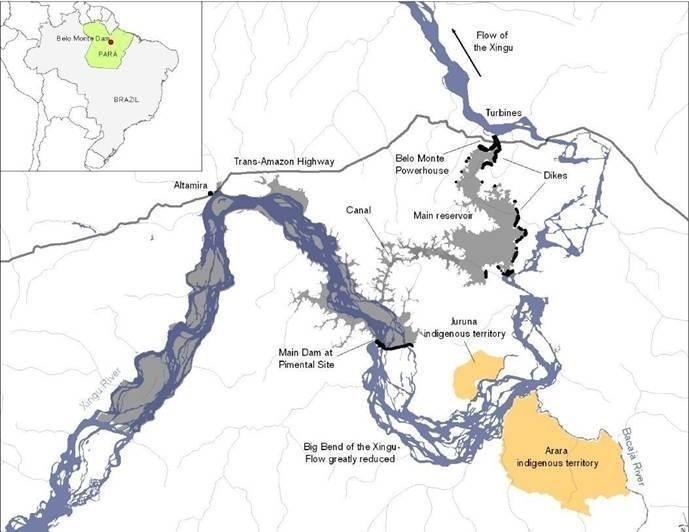
The two transmission lines connecting the North and Southeast attracted the attention of environmentalists and activists, as did the expansion of the Belo Monte plant in the Amazon to which the lines connect. The plant was criticized for its proximity to Indigenous territories and for the damage it could cause to the Xingu River and Amazon ecosystems.16 Figure 1 shows its location.
Map of the Belo Monte Hydroelectric Power Plant. Source: International Rivers Resource (2012).
More recently, SGBH’s victory in ANEEL’s 2023 auction for the GATE project—the Graça Aranha–Silvânia transmission corridor—signaled continued expansion aligned with Brazil’s energy transition. The R$10 billion investment is intended to connect renewable-energy hubs in the Northeast with demand centers in the Central-West and Southeast. SGBH therefore plays the role of a connectivity enabler, integrating intermittent renewable sources into a continental-scale grid. Beyond infrastructure, the company has pursued research, development, and innovation (RD&I) initiatives involving battery storage (BESS), artificial-intelligence-based grid monitoring, and biodiversity-protection tools.17 These local technological-adaptation efforts coexist, however, with the preservation of the company’s core proprietary advantages.
Even so, the development effects of SGBH’s presence remain contested. Although Chinese FDI has helped relieve infrastructure bottlenecks and accelerate renewable-energy deployment, its highly verticalized model may restrict domestic technological spillovers. The benefits of foreign investment depend substantially on local absorptive capacity and linkages with domestic firms and research institutions. In Brazil, limited integration of local supply chains and the predominance of imported capital goods may reduce opportunities for endogenous technological upgrading.
State Grid Brazil Holding is the emblematic case of investment by Chinese energy companies in Brazil. Its operations embody a broader tension in contemporary political economy: the coexistence of infrastructure-led development and potential forms of technological dependency. Although the company improves grid efficiency and supports decarbonization, it also deepens asymmetries in technological control and value capture. This duality highlights the need for better-calibrated regulatory and industrial policies capable of steering foreign investment toward domestic capability building.
The Divergent Case: Goldwind, a Wind-Turbine Manufacturer
In contrast to SPIC’s and CTG’s focus on large-scale generation, Goldwind represents a distinct mode of Chinese engagement centered on industrial participation within the renewable-energy supply chain. Its R$100 million acquisition of a General Electric wind-turbine manufacturing plant in Camaçari reflects a localization strategy aligned with BNDES local-content requirements, which condition access to subsidized financing on domestic production. The move illustrates how Chinese companies adapt to host-country industrial policies: they embed themselves in local manufacturing ecosystems while expanding their global competitive position. By meeting local-content standards, Goldwind not only secures market access but also contributes to the partial reindustrialization of Brazil’s renewable-energy sector through job creation and supply-chain development.18
The choice of Camaçari as a production hub was not accidental. A former petrochemical center, the region has been undergoing a structural transformation toward low-carbon industries, exemplified by concurrent investments such as BYD’s acquisition of Ford’s former facilities. This spatial clustering suggests the emergence of green industrial corridors in which foreign direct investment catalyzes sectoral restructuring and technological upgrading. Despite Goldwind’s relatively modest presence—totaling US$47 million compared with the scale of the major Chinese state-owned enterprises—its role is significant because it is a turbine manufacturer. The plant covers 50,000 square meters, has annual output of 150 units, and, according to the company, is expected to create more than 100 direct jobs as well as additional indirect employment.19
Taken together, these cases show the predominance of mergers and acquisitions followed by modernization (brownfield) over greenfield investment and joint ventures. Although this model enables rapid expansion and operating efficiency, it raises important concerns about limited embeddedness in local development. From a development perspective, greenfield investment and joint ventures are generally associated with more robust technology transfer, local supplier development, and capability building than mergers and acquisitions.20 Alon, Elia, and Li’s analysis21 of transactions by 156 Chinese multinational companies in twenty-six countries found that these firms tended to prefer greenfield investment in markets with less developed institutions and mergers and acquisitions in rule-based markets. The logic is that acquiring a company in a market governed by clear rules can help overcome the regulatory obstacles of entering a new country and facilitate organizational learning in a different regional and cultural context.
Win-Win? An Analysis of the Impact of Chinese FDI in Brazil
Electricity generation and distribution are strategic activities because they contribute to a country’s energy security and development. They are therefore overseen by government and regulatory institutions. Chinese FDI has improved Brazil’s electricity infrastructure, especially its transmission and generation capacity. Large-scale projects led by State Grid and China Three Gorges, among other companies, have strengthened grid integration by expanding long-distance transmission capacity, including UHV lines. They have also accelerated renewable-energy deployment in high-potential regions and, in many cases, contributed to grid modernization.
Where foreign investment is positioned in the value chain determines how much technological learning it leaves in the recipient country. Upstream investment in inputs tends to constrain the absorptive capacity of local firms and domestic R&D; downstream participation, such as manufacturing, fosters learning and opens more development opportunities.22 In Brazil’s power sector, this logic applies only in part—and for a reason not captured by Yu et al.’s framework.
The difference is that most of the Chinese companies analyzed here are state-owned enterprises, not conventional multinationals. Their internationalization strategies combine commercial and geopolitical objectives linked to energy security and broader strategic calculations.23 Driven by competition in advanced-technology sectors, they first built these capabilities at home and now project them abroad. In Brazil, the result is vertical integration that restricts positive FDI spillovers: the equipment used to expand power plants is imported from the companies’ own Chinese parent groups.24 The investment therefore expands renewable capacity and infrastructure efficiency but does little to transform local productive structures.
Despite these infrastructure gains, the evidence suggests that local economic spillovers remain limited. Although some projects—such as Goldwind’s and Trina Solar’s manufacturing plants—generate employment and localized industrial activity, the overall pattern is one of limited integration with domestic supply chains and continued dependence on imported equipment and components. Brazil imports more than 90 percent of its solar panels from China and is now the fourth-largest export market for Chinese panels.25 Chinese companies are deeply embedded across Latin America’s entire renewable-energy value chain rather than in isolated segments. Their activities extend from upstream mineral extraction to intermediate equipment production and downstream generation and infrastructure—a vertically integrated presence that makes it difficult for local suppliers to enter.26
Several factors could, in principle, mitigate constraints on technological spillovers and steer Chinese FDI more firmly toward local development. The most important is the quality of domestic institutions and state capacity. Brazil has relevant instruments at its disposal: clear regulatory frameworks and dedicated renewable-energy financing mechanisms, including the industrial policy recently implemented through the New Industry Brazil program (NIB). These tools are complemented by local-content provisions that condition access to subsidized BNDES financing, for example, and create structured incentives for foreign investors to develop deeper linkages with domestic suppliers and workers.
Beyond financing, the creation of R&D centers and innovation partnerships in Brazil by some of the Chinese companies analyzed in this paper—as in CTG Brasil’s ANEEL-mandated projects with SENAI—shows that regulatory obligations can generate some investment in local knowledge. Even so, the high degree of vertical integration in Chinese companies’ strategies for operating in Brazil limits the technology-transfer potential of their FDI projects.
The Northeast accounts for 26 percent of Brazil’s electricity generation and has an energy mix composed of 93 percent renewable sources. Yet the region faces institutional-coordination obstacles, regulatory uncertainty, financing bottlenecks, and infrastructure constraints. To capitalize on the global movement toward production relocation and green neoindustrialization, Brazil must create governance mechanisms and standardize project structuring to attract international capital. Financial institutions with significant Chinese capital participation—the Asian Infrastructure Investment Bank (AIIB), New Development Bank (NDB), and China Development Bank (CDB)—currently have a limited presence in the Northeast. This could be expanded through a systemic approach aimed at attracting medium- and long-term capital for new green ventures.
The most significant case in this regard is the emergence of Camaçari, Bahia, as a nascent green industrial corridor. The concentration of Chinese manufacturing investment in a single location—Goldwind’s turbine factory, Sinoma Blade’s blade plant, and BYD’s electric-vehicle complex—points to a spatial cluster capable of generating economies of scale, supplier networks, and knowledge spillovers. A critical caveat remains, however: the risk of consolidating a maquiladora model in which core components and intellectual property remain in China while Brazilian operations are restricted to final assembly, without generating productive capabilities rooted in the country.
Realizing the region’s potential as a genuine green industrial hub rather than a sophisticated assembly zone will require active industrial policy, supplier-development programs, co-investment requirements for R&D, and conditions linked to progressively higher localization targets. One possible path is an official policy for developing green industries in the Northeast that combines action by subnational entities and the federal government.
Conclusions
The expansion of Chinese renewable-energy investment in Brazil between 2014 and 2025 represents one of the most significant structural changes in the country’s energy landscape in recent decades. During this period, Chinese state-owned enterprises invested US$22.33 billion in electricity generation and transmission infrastructure, consolidating China’s position as the largest foreign investor in Brazil’s power sector. These flows cannot be explained through a purely commercial lens: they reflect a deliberate strategy to channel abroad the expansion of companies operating in sectors with excess productive capacity.
The four state-owned enterprises analyzed—State Grid, CTG, SPIC, and CGN—embody distinct but complementary forms of this strategy and have built a deeply rooted presence in Brazil’s power system that is unlikely to be reversed in the short term. The concentration of new assets in Brazil’s Northeast in the post-Covid-19 period is among this study’s most analytically significant findings. The Northeast offers high solar irradiation and the country’s greatest wind potential, together with historically deficient infrastructure—conditions that make it a rational target for renewable-energy deployment. Yet this concentration has not translated into dense industrial ecosystems. Chinese investment creates installed capacity and improves infrastructure, but local firms, suppliers, and workers capture only a fraction of the value generated.
Chinese FDI in Brazil’s renewable-energy sector produces infrastructure gains without corresponding industrial transformation. The evidence consistently reveals a dual pattern: on one side, genuine positive effects on transmission capacity, renewable-energy deployment, and grid reliability; on the other, the near-total absence of technology-transfer and supplier-development mechanisms.
Supply chains remain dependent on imports, while higher-value-added functions return to Chinese parent companies—an effect of vertical integration. Moreover, the predominance of mergers and acquisitions over greenfield investment or joint ventures further restricts local economic embeddedness.
This outcome is not inevitable. Countries that have extracted greater industrial value from foreign investment have done so through deliberate institutional design: performance-based local-content requirements, technology-transfer mandates, development-finance conditions, and coordinated regional industrial strategies—together with the strategic coherence to deploy these instruments in an integrated manner aligned with a long-term development plan.
Brazil therefore faces a decisive strategic choice. The global energy transition is not only an environmental imperative but also an industrial and geopolitical contest in which control over renewable technologies and supply chains increasingly determines national power. China clearly understands this. Brazil has the resources, market scale, and institutional capacity to be more than a passive recipient of this transition. This is a landscape open to bargaining and planning—but its window of opportunity is narrowing over time.
Policy Recommendations
The pattern identified in this study—infrastructure gains without industrial transformation—does not result from a failure by investors, which act according to their own corporate and strategic logic. It results from the absence of a Brazilian institutional design capable of converting market scale into bargaining power. Brazil has the tools; what is missing is their coordinated use with verifiable targets. The following recommendations are ordered according to their balance of feasibility and impact.
1. Convert BNDES Local-Content Requirements into Progressive Performance Targets
The Goldwind case analyzed in this study demonstrates that local-content requirements tied to access to subsidized credit do alter production-location decisions. The instrument’s limitation is its static character: once the minimum percentage is reached, the incentive for further deepening disappears. The fixed percentage should be replaced by a phased localization trajectory over the life of the financing agreement, with periodic assessment and links to supplier-development plans submitted by the borrower. Loss of the benefit in the event of noncompliance should be gradual and predictable in order to preserve the legal certainty that supports the country’s attractiveness.
2. Introduce Productive-Development Criteria into Energy Auctions
Brazil’s auction system is sophisticated and produces competitive tariffs, but it optimizes a single variable: the price of energy. Brazil should consider introducing complementary ranking criteria in a portion of auctions, tied to local content, supplier qualification, or commitments to R&D conducted in Brazil.
Nontariff criteria raise energy costs, which are borne by consumers and affect the competitiveness of energy-intensive industry—the very sector the policy aims to strengthen. The proposal should therefore be applied only in part and preceded by an assessment of tariff impacts, rather than used to redesign the model as a whole.
3. Redirect Part of ANEEL’s R&D Funding Toward Supplier Development
CTG Brasil’s projects with SENAI show that regulatory obligations generate investment in local knowledge. The problem is one of direction: resources tend to finance projects of interest to the concessionaire itself, with limited spillovers to the productive base. A portion of the mandatory R&D program should be reserved for shared infrastructure—testing laboratories, component certification, and qualification of domestic suppliers—with governance that includes industry organizations and research institutes rather than only the concessionaires subject to the requirement.
4. Structure Camaçari as a Deliberate Industrial-Clustering Policy
The convergence of Goldwind’s turbine factory, Sinoma Blade’s blade plant, and BYD’s complex constitutes the most promising cluster identified in this study—and also the clearest risk of consolidating a final-assembly model without productive embeddedness. Brazil should create a territorial program with three components: negotiated targets for progressively higher localization of components; a local supplier-development program with dedicated financing; and a requirement for co-investment in engineering and development activities carried out locally, not merely in assembly operations.
5. Build an Investment-Attraction Agenda with Development Banks That Include Chinese Participation
The Asian Infrastructure Investment Bank (AIIB), New Development Bank (NDB), and China Development Bank (CDB) currently have a limited presence in the Northeast, despite the region’s concentration of Brazil’s greatest renewable-energy potential. Brazil should assemble a standardized regional project pipeline ready for presentation to these financiers, with legal and environmental structuring resolved in advance. The bottleneck is not a lack of available capital but a shortage of sufficiently mature projects capable of accessing it.
6. Operationalize Powershoring as Federal Policy and Bring It into the Bilateral Channel
Powershoring—the attraction of energy-intensive manufacturing to regions with abundant and affordable renewable energy—remains a concept without an implementing instrument. It should be formally incorporated into the New Industry Brazil program, with priority sectors defined, mechanisms connecting energy supply and industrial demand, and measurable targets.
Because the companies analyzed in this study are predominantly state-owned enterprises whose investment decisions respond to policy directives from Beijing, the technology-transfer agenda must also be addressed through the bilateral channel, not only through domestic regulation. The China-Brazil High-Level Commission for Consultation and Cooperation (COSBAN) is the natural forum for this negotiation.
Notes
- Ember, “China Energy Transition Review 2025,” 2025, https://ember-energy.org/latest-insights/china-energy-transition-review-2025/; “China Sets Renewables Goal It Can Easily Surpass, Analysts Say,” Reuters, September 25, 2025, https://www.reuters.com/sustainability/cop/china-sets-renewables-goal-it-can-easily-surpass-analysts-say-2025-09-25/.
- Alex L. Wang, Chinese Global Environmentalism (Cambridge University Press, 2026), https://doi.org/10.1017/9781009363976.
- Barry Naughton, The Rise of China’s Industrial Policy, 1978 to 2020 (Boulder, CO: Lynne Rienner Publishers, 2021), https://doi.org/10.1515/9786078066605; Francisco Urdinez, Economic Displacement: China and the End of US Primacy in Latin America (Cambridge University Press, 2026), https://doi.org/10.1017/9781009672238.
- Tulio Cariello, “Investimentos Chineses no Brasil 2025: Mineração, Mobilidade Elétrica e Renováveis,” China-Brazil Business Council, 2026, https://www.cebc.org.br/investimentos-chineses-no-brasil/.
- Forbes, “Brasil representa 60% dos investimentos da State Grid fora da China,” October 17, 2019, https://forbes.com.br/negocios/2019/10/brasil-representa-60-dos-investimentos-da-state-grid-fora-da-china/.
- Celio Hiratuka, “Brazil-China Economic Relations in the First Two Decades of the 21st Century: An Analysis Based on Contemporary Challenges for Brazilian Reindustrialization,” Economia e Sociedade 33, no. 3 (2024), https://doi.org/10.1590/1982-3533.2024v33n3.282874.
- SPIC Brasil, “Sustainability Report 2024,” 2025, https://www.spicbrasil.com.br/wp-content/uploads/2025/05/RS_2024_SpicBrasil_ENG_V7-1.pdf.
- SPIC Brasil, “Sustainability Report 2024,” 2025, https://www.spicbrasil.com.br/wp-content/uploads/2025/05/RS_2024_SpicBrasil_ENG_V7-1.pdf.
- SPIC Brasil, “Sustainability Report 2023,” 2024, https://www.spicbrasil.com.br/en/wp-content/uploads/sites/5/2024/08/Spic_RS23_ENG_D1f-1.pdf; SPIC Brasil, “Sustainability Report 2024,” 2025, https://www.spicbrasil.com.br/wp-content/uploads/2025/05/RS_2024_SpicBrasil_ENG_V7-1.pdf.
- CTG Brasil, “Relatório Anual de Sustentabilidade 2024,” 2025, https://www.ctgbr.com.br/relatorioanual2024/; CTG Brasil, “Relatório Anual de Sustentabilidade 2025,” 2026, https://www.ctgbr.com.br/relatorioanual2025/.
- Ricardo Lopes Kotz and Maria José Haro Sly, “China’s Economic Diplomacy in the Context of the Far-Right Government’s Neoliberal Nationalism: The Case of Brazil’s Energy Sector,” in New Nationalisms and China’s Belt and Road Initiative: Exploring the Transnational Public Domain (Cham: Springer International Publishing, 2022), 195–215, https://doi.org/10.1007/978-3-031-08526-0_14.
- Ricardo Lopes Kotz and Maria José Haro Sly, “China’s Economic Diplomacy in the Context of the Far-Right Government’s Neoliberal Nationalism: The Case of Brazil’s Energy Sector,” in New Nationalisms and China’s Belt and Road Initiative: Exploring the Transnational Public Domain (Cham: Springer International Publishing, 2022), 195–215, https://doi.org/10.1007/978-3-031-08526-0_14.
- State Grid Brazil Holding, “Sustainability Report 2024,” 2025;
- State Grid Brazil Holding, “Sustainability Report 2025,” 2026,
- Ricardo Lopes Kotz and Maria José Haro Sly, “China’s Economic Diplomacy in the Context of the Far-Right Government’s Neoliberal Nationalism: The Case of Brazil’s Energy Sector,” in New Nationalisms and China’s Belt and Road Initiative: Exploring the Transnational Public Domain (Cham: Springer International Publishing, 2022), 195–215, https://doi.org/10.1007/978-3-031-08526-0_14.
- Ricardo Lopes Kotz and Maria José Haro Sly, “China’s Economic Diplomacy in the Context of the Far-Right Government’s Neoliberal Nationalism: The Case of Brazil’s Energy Sector,” in New Nationalisms and China’s Belt and Road Initiative: Exploring the Transnational Public Domain (Cham: Springer International Publishing, 2022), 195–215, https://doi.org/10.1007/978-3-031-08526-0_14.
- State Grid Brazil Holding, “Sustainability Report 2024,” 2025, https://stategrid.com.br/wp-content/uploads/2025/05/SGBH_RS24_ING_VFb.pdf; State Grid Brazil Holding, “Sustainability Report 2025,” 2026, https://stategrid.com.br/wp-content/uploads/2026/04/SGBH_RS25_ING_VFb.pdf.
- Government of the State of Bahia, “Nova Fábrica de Turbinas Eólicas da Goldwind Recebe Investimento de R$ 100 Milhões e Fortalece Liderança da Bahia em Energia Renovável,” August 28, 2024, https://www.ba.gov.br/casacivil/noticias/2024-08/2281/nova-fabrica-de-turbinas-eolicas-da-goldwind-recebe-investimento-de-r-100; “Goldwind Wins Order in Brazil,” Windtech International, December 31, 2024, https://www.windtech-international.com/projects-and-contracts/goldwind-wins-order-in-brazil.
- Government of the State of Bahia, “Nova Fábrica de Turbinas Eólicas da Goldwind Recebe Investimento de R$ 100 Milhões e Fortalece Liderança da Bahia em Energia Renovável,” August 28, 2024, https://www.ba.gov.br/casacivil/noticias/2024-08/2281/nova-fabrica-de-turbinas-eolicas-da-goldwind-recebe-investimento-de-r-100.
- Philipp Harms and Pierre-Guillaume Méon, “Good and Bad FDI: The Growth Effects of Greenfield Investment and Mergers and Acquisitions in Developing Countries,” Université libre de Bruxelles Working Paper, 2014, https://dipot.ulb.ac.be/dspace/bitstream/2013/174783/1/wp14021.pdf.
- Ilan Alon, Stefano Elia, and Shaomin Li, “Greenfield or M&A? An Institutional and Learning Perspective on the Establishment Mode Choice of Chinese Outward Investments,” Journal of International Management 26, no. 3 (2020), https://doi.org/10.1016/j.intman.2020.100758.
- Lina Yu, Zenghui Guo, and Jing Ning, “Foreign Multinational Global Value Chain Participation and Domestic Innovation: Viewing GVCs Inside-Out and Outside-In,” Journal of Innovation & Knowledge 9, no. 4 (2024), https://doi.org/10.1016/j.jik.2024.100603.
- Alex L. Wang, Chinese Global Environmentalism (Cambridge University Press, 2026), https://doi.org/10.1017/9781009363976; Kehan Wang, “From Minerals to Megawatts: Understanding Chinese Involvement in Latin America’s Renewable Energy Value Chain,” Latin America, China and a Just Energy Transition: Working Paper Series (Universidad del Pacífico Center for China and Asia-Pacific Studies and Boston University Global Development Policy Center, 2026), https://doi.org/10.21678/cechap.2026.jet.dt2.
- Kehan Wang, “From Minerals to Megawatts: Understanding Chinese Involvement in Latin America’s Renewable Energy Value Chain,” Latin America, China and a Just Energy Transition: Working Paper Series (Universidad del Pacífico Center for China and Asia-Pacific Studies and Boston University Global Development Policy Center, 2026), https://doi.org/10.21678/cechap.2026.jet.dt2.
- Henry Ziemer, “Power Moves: How China’s Energy Investments Provide Durable Influence in South America,” Center for Strategic and International Studies, October 15, 2025, https://www.csis.org/analysis/power-moves-how-chinas-energy-investments-provide-durable-influence-south-america; Antonio Carlos Sil, “Módulos Fotovoltaicos Foram o 4º Produto Mais Importado da China pelo Brasil em 2025,” Canal Solar, January 14, 2026, https://canalsolar.com.br/modulos-fotovoltaicos-4o-produto-importado-china/.
- Kehan Wang, “From Minerals to Megawatts: Understanding Chinese Involvement in Latin America’s Renewable Energy Value Chain,” Latin America, China and a Just Energy Transition: Working Paper Series (Universidad del Pacífico Center for China and Asia-Pacific Studies and Boston University Global Development Policy Center, 2026), https://doi.org/10.21678/cechap.2026.jet.dt2.
Cover images courtesy of the companies: São Simão Hydropower Plant, on the border between Santa Vitória (Minas Gerais) and São Simão (Goiás) / SPIC Brasil; LDB Wind Farm, Lagoa do Barro do Piauí (Piauí) / Goldwind; Nova Olinda Solar Park, Ribeira do Piauí (Piauí) / CGN Brasil.il.